

!DOCTYPE html PUBLIC "-//W3C//DTD XHTML 1.0 Transitional//EN" "http://www.w3.org/TR/xhtml1/DTD/xhtml1-transitional.dtd"> Emerging Women .comment-link {margin-left:.6em;}
Thursday, December 27, 2007
The Real Mary - Week 4
I hope everyone had a blessed Christmas. Although postponed a couple of days, I wanted to post the final post for out discussion of Scot McKnight's The Real Mary. Most of this I posted on my blog last year after I first read the book, but I wanted to share these ideas here since the theme of how Mary gets portrayed is so prominant in the book.

What really intrigued me was the discussion of how Mary has been portrayed in art and how that has influenced our perceptions of her. Most depictions of Mary present her as emotionless, ageless, and weak in a pale blue dress. She is decorative, humble, and seemingly powerless. I had never been a fan of religious art mostly because of the way it portrays "holy" figures as disconnected from real life. The Marys in art obviously have not just given birth, finished a long journey, or had recently been on a roller-coaster emotional journey. They are not surprised by the appearance of an angel, are not phased by the request from God, and are not upset by a serious life change. And they are not the kind of women who could sing a politically revolutionary song like the Magnificat. Perhaps that is why when I first encountered Ecce Ancilla Domini by Dante Gabriel Rossetti I was drawn to it. Although it makes use of a lot of the traditional symbols associated with Mary, it challenges tradition as well. Of course in expected fashion it was rejected by critics of Rosetti's day because it was new and different. Contemporary critics howled with outrage at the picture, denouncing it as ‘an example of the perversion of talent which has recently been making so much headway’. I liked it because it depicts a Mary who has emotions - who reacts in some way to the appearance of the angel and his startling request. Here she is scared to death, cowering in the corner, unsure of her fate. Rossetti (using his sister Christine Rossetti as a model) portrays a real person here and I like that.
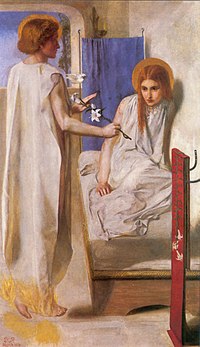
But I'm not sure the portrayal is accurate. Yes, I believe there was surprise and fright involved in the encounter. But Rosetti's Mary doesn't look like she would willingly say "may it be to me as you have said" in response to this angel. This angel with the phallic symbol lily pointed at Mary's womb seems to represent the worst form of male violence towards women. One is reminded of Yeat's poem Leda and the Swan retelling the Greek myth of the maiden being raped by the god. But I can't seem to figure rape into the Christmas story - the God I believe in (the God I want to believe in) is not like that. I have to think that Mary's "may it be" was a true willingness. I like the description of Mary's willingness from the poem Annunciation by Denise Levertov - "She was free/to accept or to refuse, choice/integral to humanness." Mary knew what she faced, she knew the dangers and she still willingly accepted to bear the Messiah. As Scot McKnight mentioned "may it be" might be better translated as "bring it on," this was a women with fire in her eyes ready to serve and serve big.

I like that vision of Mary. I like finding strong women in the Bible who aren't afraid to challenge tradition and cultural assumptions in order to work for a greater good. I like that - that's the Bible I want to share with my daughter. But I have yet to find it in art. What will it take for the concept of a strong and revolutionary Mary to enter the religious consciousness? What will it take for the church to accept a woman with fire in her eyes? Will she (they) just continue to be shoved out of churches or subdued and tamed? What will it take for Mary to be re-imagined by the masses? Given the church's track record with women, I'm not expecting much. But this is a story I will tell - a picture I will paint differently.

Labels: ,

 
posted by Julie at 4:25 PM ¤ Permalink ¤ 1 comments
Tuesday, December 18, 2007
The Real Mary - Week 3
"Oh my God, I've lost the Messiah!!!"

Can you imagine it? I can only begin to. The terror and the panic that come when a child is missing for even two seconds are overwhelming (and really, she wasn't missing; you just couldn't see her) .... but Mary, the mother of God, in full knowledge that her son was the promised Messiah - couldn't find him. He'd been missing for almost a day before she realized He was gone. Can you imagine the questions and the worries that swirled through her head for the three days it took to find Him?

"What kind of a mother am I?" "How could He do this to me?" "What if something happened to Him?" "What will God say?" And then His answer... "Didn't you know I would be in my Father's house?" It seemed perfectly logical to Him... and it stopped Mary in her tracks.

Should she have known?

What has struck me as I've read McKnight's book is the way that Mary's understanding of Jesus shifted as He grew up and began to live into His destiny. Jesus knew the road He needed to take, but His mom didn't always understand it. McKnight says, "We can understand Mary's struggle. No one, including Mary, anticipated the kind of Messiah Jesus would become. Following Jesus proved as difficult for Mary as for Peter and for John the Baptist...and for the siblings of Jesus. Mary's special challenge was to trust that the God who spoke to her in and through the Magnificat was at work in Jesus in his ministry and his mission. While the two visions of the Messiah - the one in the Magnificat and the one guiding Jesus' public ministry - didn't seem to fit, it was hers to trust that Jesus really was the Messiah." (p. 85)

"Embracing a Messiah who would make death on a cross central to his role challenged Mary's faithfulness more than anything she would face." (p. 94) But she remained faithful, from the day Gabriel first spoke to her until the day she died.... "The Magnificat's dream of a society governed by justice with peace streaming through the streets would come through the paradox of the Cross, the power of the Resurrection, and the life-giving creativity of the gift of the Spirit of God. The society Mary anticipated...would come to pass in the Church." (p. 96-97) And Mary was right there in the middle of it. She remained faithful to what God had spoken to her, even when she didn't understand what He was doing. That challenges me to question my own willingness to do that.

Just a couple of questions for discussion this week:

How has re-visiting Mary's story in this book changed your perspective on Mary?

How has it challenged or encouraged you in your own walk with God?

And just for fun: how does McKnight's portrait of Mary as a woman of faith, justice, danger, witness, sorrow, wonder, surrender, ambivalence, faithfulness, influence, and controversy measure up against the societal portrait we've been given by artists and musicians over the years? do you have a favorite painting or a favorite song about Mary that's been either completely ruined for you or become more special, as result of what you've learned about Mary?

Labels: ,

 
posted by Happy at 12:00 AM ¤ Permalink ¤ 0 comments
Tuesday, December 11, 2007
The Real Mary - Week 2
Today we continue our discussion of Scot McKnight's The Real Mary. As I read this book one of the portrayals of Mary that really stood out to me was that of Mary as a woman of justice. Taking the words of Mary's song, often called the Magnificat, one can see that Mary stood for justice for the oppressed in an almost revolutionary sort of way. Just read over those words again -
Mary's Song
And Mary said:
"My soul glorifies the Lord
and my spirit rejoices in God my Savior,
for he has been mindful
of the humble state of his servant.
From now on all generations will call me blessed,
for the Mighty One has done great things for me—
holy is his name.
His mercy extends to those who fear him,
from generation to generation.
He has performed mighty deeds with his arm;
he has scattered those who are proud in their inmost thoughts.
He has brought down rulers from their thrones
but has lifted up the humble.
He has filled the hungry with good things
but has sent the rich away empty.
He has helped his servant Israel,
remembering to be merciful
to Abraham and his descendants forever,
even as he said to our fathers." (Luke 1:46-55)

Scot McKnight writes that "if we read Mary's song in Mary's real world, we will see that it is a song about turning injustices inside out and power upside down." The words of her song about bringing down rulers were subversive. She sided with the poor and oppressed in the face or a corrupt King and rejoiced that God through her was providing help for his oppressed people.

This isn't Mary "meek and mild," this is a woman who has faced hardship and struggle. This is a woman who knows the scriptures and knows the promises God has made. This is a woman who will stand up for the justice promoted in scripture even if it is unpopular or dangerous.

So how do you handle this view of Mary? Is this a new perspective for you?
In what ways do you see the Magnificat as a song about justice?
Do you think Jesus' constant emphasis on justice for the oppressed was something her learned from his mother?
How does this view of Mary inspire you?

Labels: ,

 
posted by Julie at 12:34 AM ¤ Permalink ¤ 1 comments
Tuesday, December 04, 2007
The Real Mary - Week 1
During the month of December we will be discussing Scot McKnight's book The Real Mary. The Christmas season is in reality the only time of year that many of us in Protestant traditions ever hear Mary mentioned at all. But beyond her fulfilling her role of birthing a son, she often remains a background figure, unimportant to the story of our faith. McKnight's book is written mainly to those from Evangelical traditions to help us expand our knowledge of who Mary is, but I hope that all of us, whatever our faith tradition, can use this discussion to come to a better understanding of a very strong and dynamic woman.

To start our discussion, I think it would be helpful for us to share what our experience with Mary has been.
  • What do you know about Mary?

  • What impressions do you have of Mary?

  • How were the stories of Mary presented in your church tradition?

  • Is discussing Mary natural for you, or does it seem slightly dangerous?


In reading this book I discovered a new perspective on Mary and elements of her character that I had never considered before. I look forward to exploring some of those here over the next few weeks as we discover together the story of a woman who is so much more than just a supporting character in the Christmas story.

Labels: ,

 
posted by Julie at 12:07 AM ¤ Permalink ¤ 9 comments